Halo — high aperture, low overhead. A seven-foot ring that wraps tape around anything you can slide through it.
The trade has several names for this machine and they all mean the same motion: an orbital wrapper, a ring wrapper, a horizontal orbital strapper, or just a panel strapper. The work stands still and the tape orbits it. Commercial ones start in the tens of thousands of dollars and are built for a production line. This is the shop-built version: sheet offcuts, four skate wheels, and a hand crank.
A machine for a job I do badly by hand.
It was not drawn in a drawing program. Every part of it was written as code by CAD/CAM software I wrote myself, which means the design carries its own tests and the cutting files and the 3D model cannot disagree — they are the same thing. The design story is a separate page, written against myself. This one is the short version, for someone who might want the machine.
What it does
Cabinet parts leave the shop wrapped — end panels, fillers, long mouldings, some of them more than four feet wide. Strapping one means running a band of tape right around it, so the wrap cannot slide off the end. By hand that is two people and a lot of walking, or one person rolling a finished panel over on the bench, which is how finished panels get marked.
This turns the job around. The work stands still on a lift and the tape goes around it. A ring seven feet across carries the tape roll; you slide the panel through the middle of the ring, turn the ring one and a half times, cut the tape, slide the panel along, and strap it again.
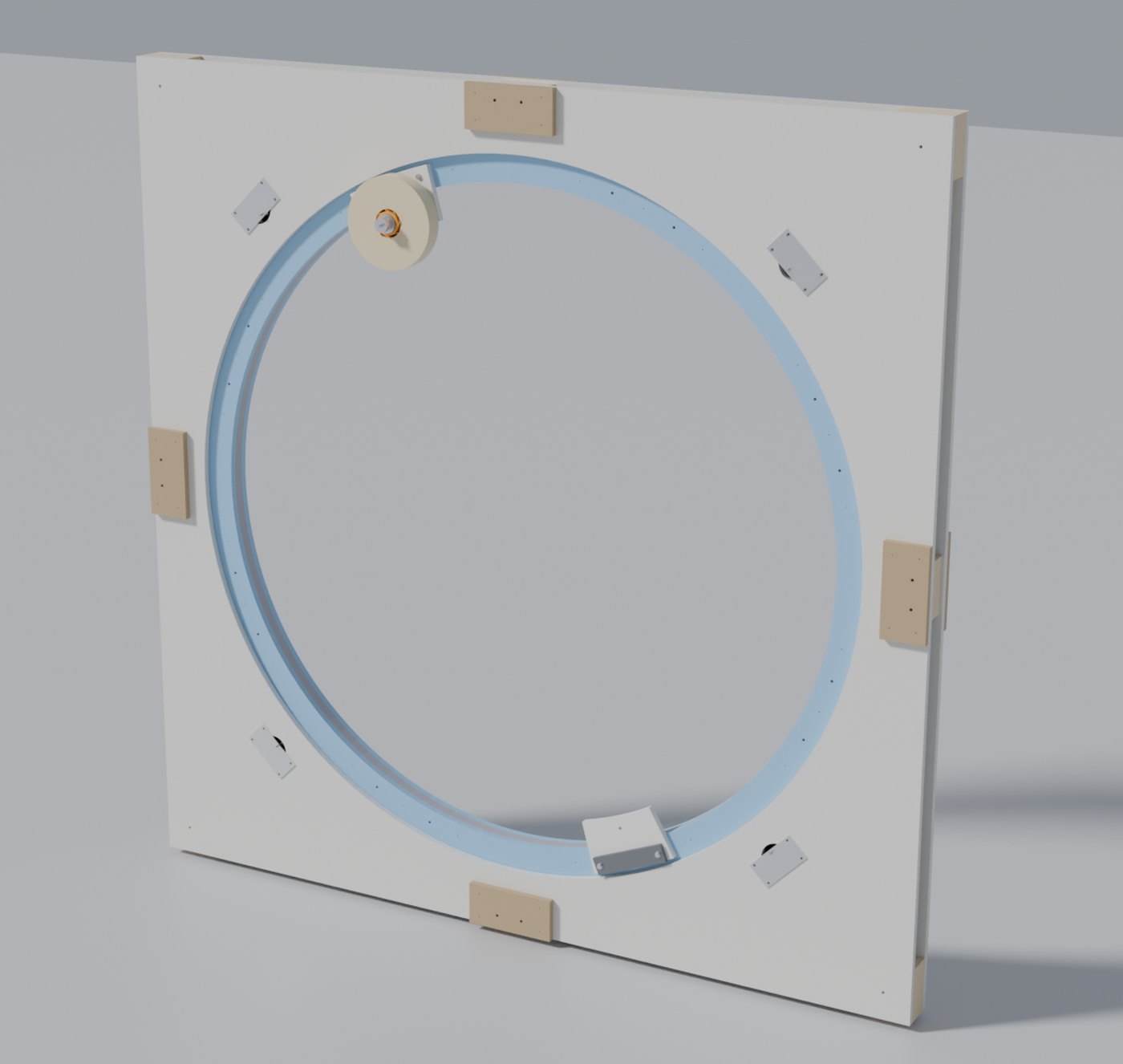
The machine as drawn. The square is a wall of sheet stock; the pale blue circle inside it is the ring, and the roll of tape rides on the ring. The small plates are the wheel mounts the ring turns on. Nothing here has been built.
How it is built
Like a computer case fan. Two square panels with a round hole through each, the ring sandwiched between them, everything through-bolted. Four inline-skate wheels sit at the corners of the hole and the ring rides on them — the bottom two carry its weight, the top two stop it lifting. The wheels are the only bearings in it.
The ring itself is four layers of sheet stock glued and screwed together: a thick layer, two thinner ones, a thick layer. The middle two stop short of the outer two, and the step that leaves is the channel the wheels run in.
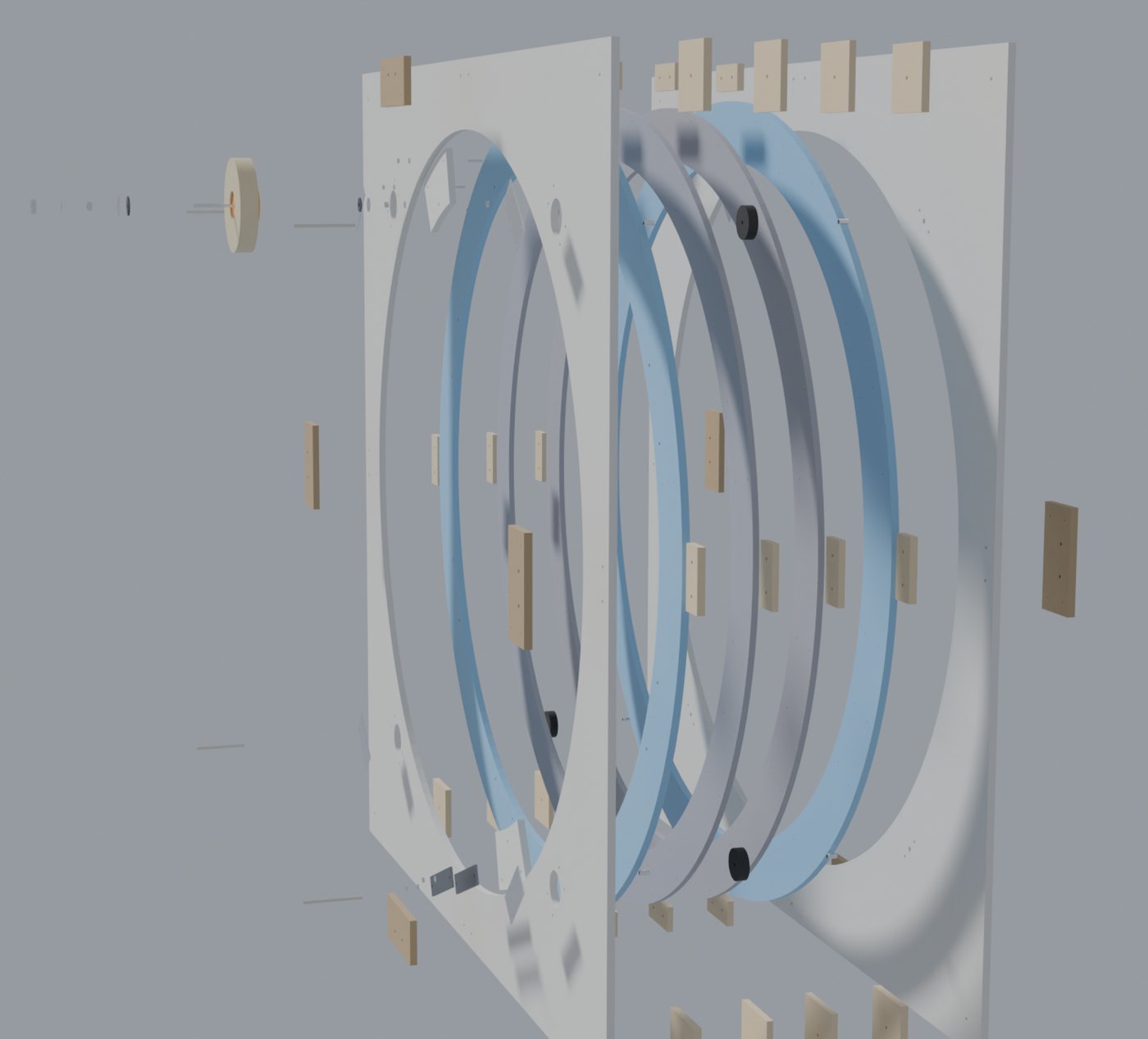
Pulled apart. Two panels, four ring layers, and the blocks that set the gap between the panels. Every piece except the wheels, the bolts and the brackets is cut from sheet stock on a CNC router.
It goes together in about twenty-five steps, and the model knows all of them — which piece, in which order, against which face. That is worth more than a picture of the finished thing, because it is the part a builder has to get right.
The whole build, step by step, from the 3D model — back panel first, then the ring layers, the spacers, the skate wheels, the front panel, the axles, and the tape head last. Every piece you see is the shape the router would cut. Nothing in this film has been built.
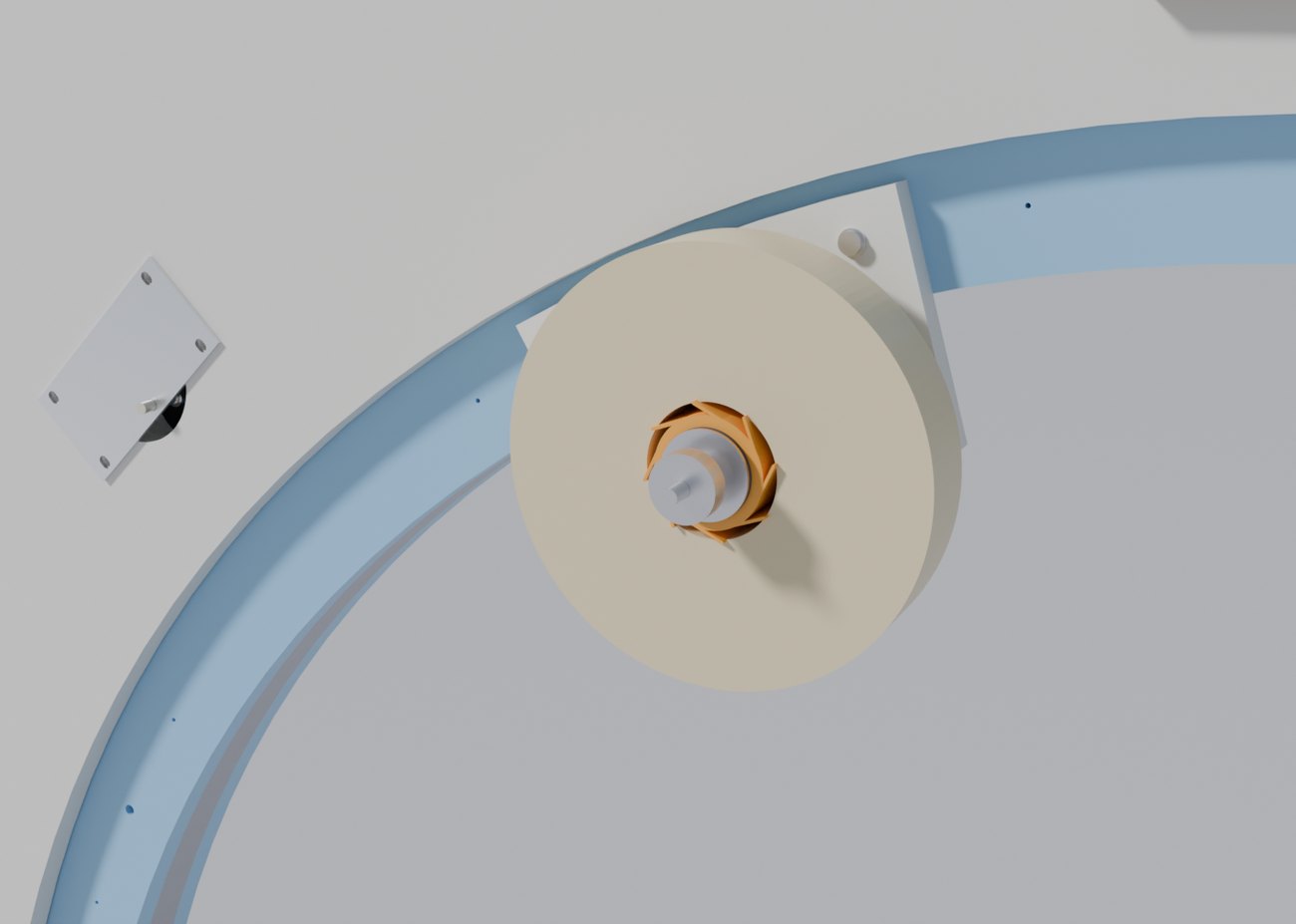
The tape head. The roll sits on a 3D-printed hub whose fins press into the cardboard core, with a friction brake so the tape stays tight as the ring turns. A counterweight rides opposite it.
Numbers
All of these come off the 3D model, not off a sketch.
| Clear opening through the ring | 72 in |
| Largest work it will actually take | 56 in — the tape roll eats the rest |
| Overall | 92 in square, about 3 in thick |
| Weight of the ring alone | 99 lb |
| Weight of the whole thing, no stand | 264 lb |
| Bought parts | about $352 CAD, estimated, range $246–$458 |
| Sheet stock | offcuts — in my shop, free |
The $352 is every wheel, bolt, bearing, nut and spacer, priced from the model’s own parts list. It is an estimate at retail, not a quote, and it does not include the stand, a crank, or a motor.
What is drawn and what is not
Drawn, checked, and ready to cut: the ring, both panels, the spacer blocks and splice plates, the wheel mounts, the tape head and its counterweight. Every flat part exists as a cutting file. The model carries its own tests — interference, clearance and mass — and they pass at every position the ring can turn to.
Not drawn: the stand it sits on, the hand crank that turns it, and the guards over the four points where a wheel meets the ring. Those four are pinch points and the machine should not be turned without the guards.
Not cut. No part of this has been made. The plan is to cut two small test pieces first — one a corner block, one a slice of the ring’s curve — to prove the router does what the files say before committing a sheet to a seven-foot circle.
What I would tell a buyer
Halo is built from what a cabinet shop already has: sheet offcuts, a CNC router, a few dollars of skate wheels. That is the low overhead half of the name, and it is also the catch. It is heavy, it is big, and it wants a scissor lift in front of it to bring the work to the middle of the ring. It turns by hand on purpose — a 99 lb ring with a motor on it and no guards is a machine that hurts somebody.
If you strap wide panels and this looks like it would earn its floor space, email me: contact@justinlaviolette.com. Tell me the widest thing you wrap and what you cut sheet stock on. I would rather talk to one person who needs it than publish files nobody builds. No price and no download yet, because nothing has been cut yet.
And if what interests you is how a machine gets designed this way — by a language model working against its own checks, with me catching what the checks missed — that is the other page.