Part 1 built a simulator that grades a toolpath by engagement — how much of the cutter’s width is buried in material at each moment — with 55% as the limit. This is what happened when I graded everyone else’s toolpaths with it.
The one that beat both has no corner code
The next step was to stop guessing and read what everybody else does. I ran five open-source toolpath libraries over the same test shape and graded them with my own measure — including FreeCAD’s Adaptive, which holds under the 55% line just as Fusion does, and is free.
Its trick is a single idea, and not the one I expected. It doesn’t plan a route and then measure how hard the cut turned out to be. It steers. Every tenth of a millimetre it tries headings until it finds the one where the material about to be swept up matches its target load, then goes that way. Engagement isn’t something it checks afterwards. Engagement is the steering wheel.
It has no corner-handling code. Corners are the hard part of this problem: an inside corner is where a cutter on an obvious route finds material on two sides and takes a far bigger bite than it took a moment before. Every approach I had written carried special-case machinery for corners, and I spent four rounds of work on that machinery. FreeCAD needs none. A corner is another place where the steering sees material ahead and turns away, for the same reason it turns anywhere else.
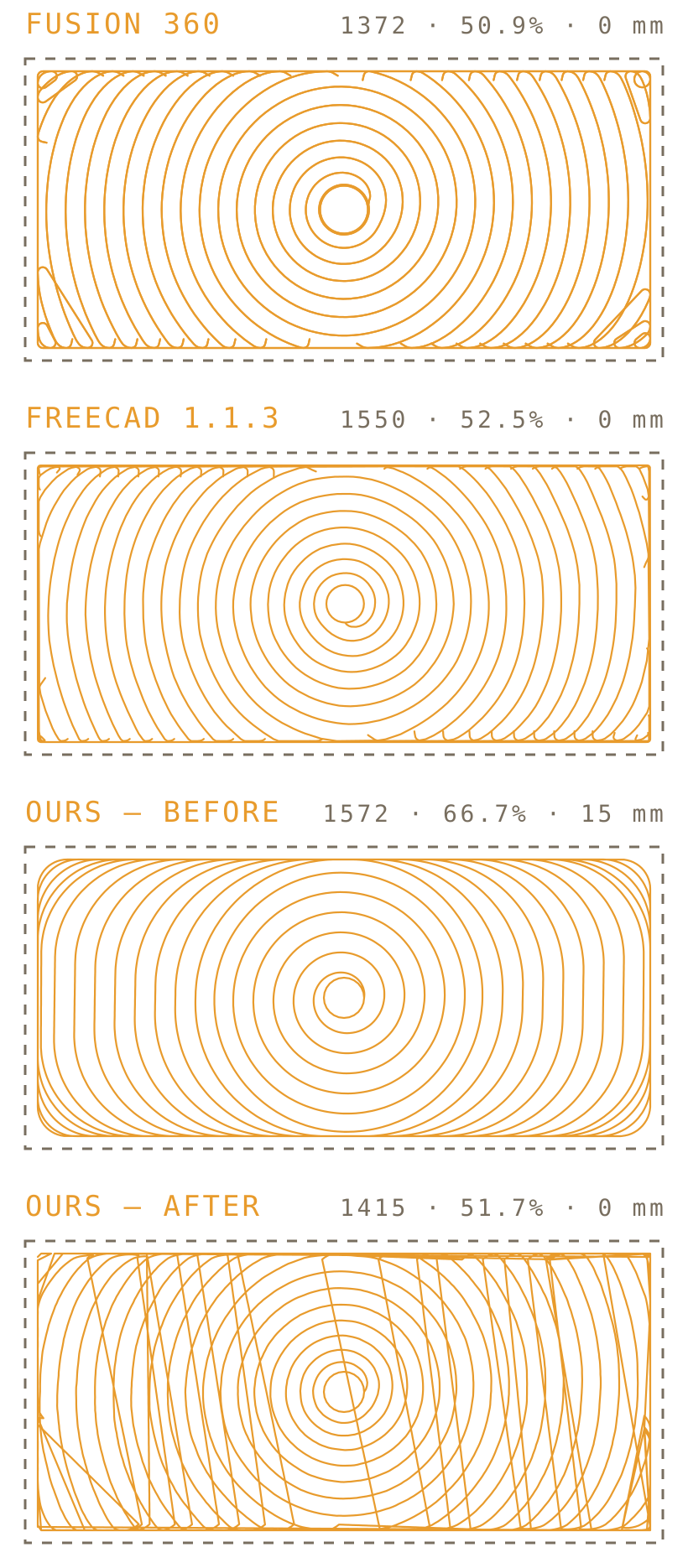
That figure is the argument for reading other people’s work before writing more of your own. The busy-looking route is the good one: it never crosses the 55% line, and it finishes in a shorter distance than the reference that taught it.
The reference couldn’t pass its own test
Then a more uncomfortable finding. I had been quoting FreeCAD’s score as a bar to clear. It isn’t a bar. It’s a sample.
Run the identical job over and over and you get a different answer each time. Across nine runs the hardest bite the cutter took ranged from 51.4% to 59.2% — straddling the 55% line, so it fails its own target roughly one run in three. Of four runs I compared line by line, all four were different programs. Two causes, both in the shipped code: a random number generator that is never given a fixed starting seed, and a half-second time budget in one step, which makes the result depend on how busy the computer was at that instant.
The same kind of error had cost me eight rounds of tuning. One of my quality targets was “corner engagement under 39%”, which I chased as a hard maximum. 39% was Fusion’s median — its middling case, the number it beats half the time and misses the other half. I had been demanding that every corner of my toolpath beat what the reference manages only half the time.
A number without its conditions isn’t a measurement. And if the reference can’t pass the target you took from it, the target is the bug.