The simulator from Part 1 plays a G-code file move by move and keeps a clock. This is what the clock said about the first real cutting file — and the most recent thing measurement corrected.
When I watched the simulator play that file, the cutter crawled through open space. Those were repositioning moves — hops from the end of one pass to the start of the next, over ground already cleared — but they ran at cutting speed rather than travelling speed. Across the whole file, 48.8% of the job is the cutter moving through nothing, and the true cycle time was 8 minutes 57 seconds, not the 4:34 I had been telling people. I had read the “cutting time” figure and repeated it as the total, when the next line said how much air came with it.
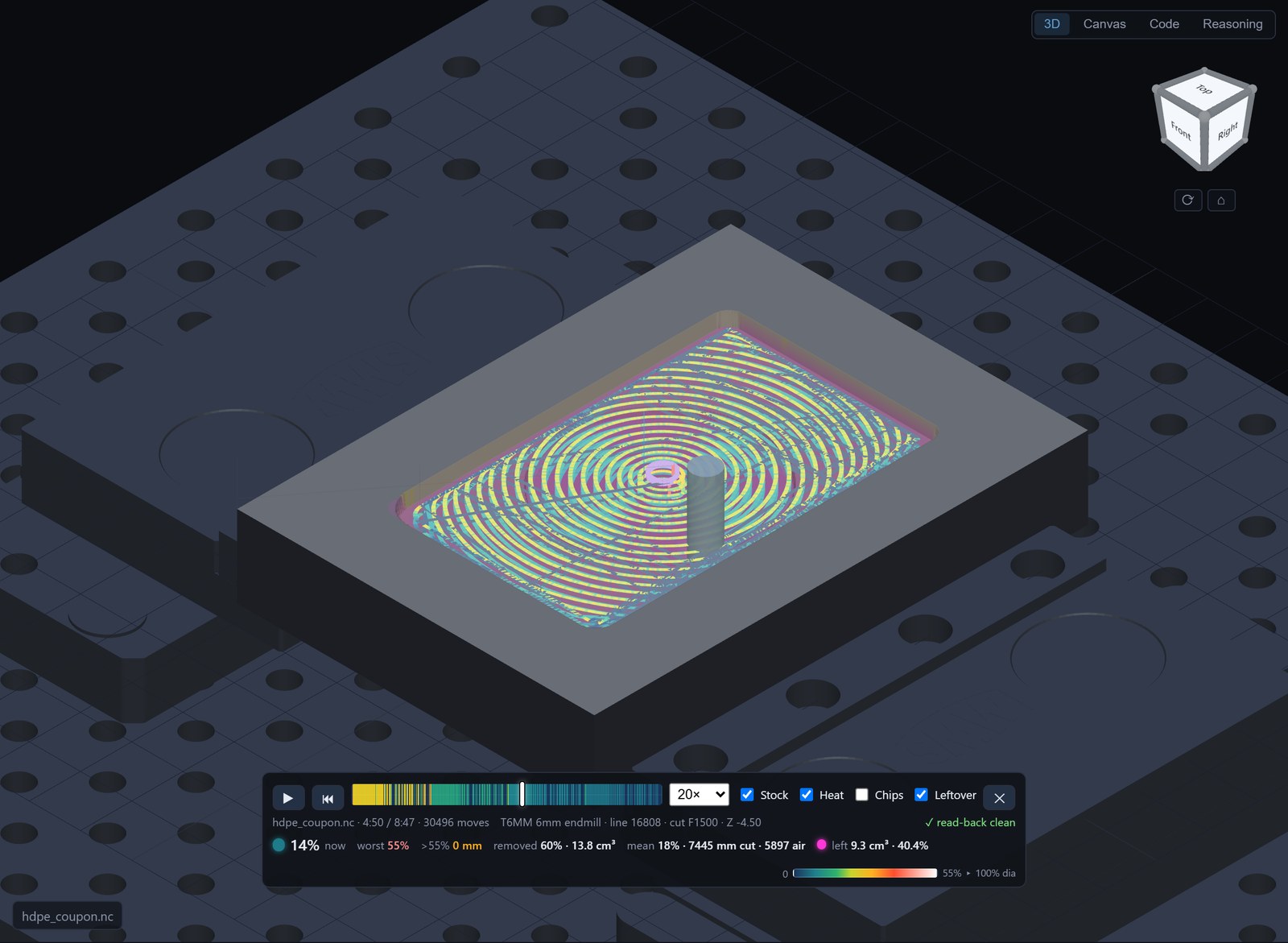
The first cutting file, part-way through. The readout under the picture is where the two clocks live: ‘cut’ is the time spent removing material, ‘air’ is the rest. I had been quoting the first and calling it the total.
The fix was to let a move the simulator knows is over cleared ground run at the faster speed. And the fix had to be measured too, because I predicted it would save 2.8 minutes and the honest answer is 10 seconds. A machine can’t change speed instantly — it needs a couple of millimetres to wind up to a faster rate and as much again to slow down — and nearly all of those hops are shorter than that, so a higher speed setting never takes effect. An improvement you predicted is not an improvement you made.
Getting that time back means eliminating the hops, which is a routing problem, not a speed problem. That is the next piece of work.
Where it stands
The first cutting file is written: a rectangular recess 50 × 80 mm and 6 mm deep, taken out in four passes, in a block of HDPE plastic, cut with a 6 mm end mill. Nine checks apply to that file and all nine pass, along with 107 automated tests. One of the nine is against the clamp, which I measured and located in the machine’s own coordinates so the software knows where the metal it must not hit sits.
It has not cut anything yet. The plan is for a coupon — a simple test piece whose only job is to prove the process before a real part is risked. The machine is waiting on one measurement that can only be taken standing at it: where the corner of the block sits on the table, found by hand. Everything upstream of that is done and checked. Everything downstream is unproven, and I would rather say so than imply the software has been validated by metal it has never touched.